Book Review: Quarterly Essay 102, 2026

When you take to reading a book you always have some levels of expectations. With this essay I thought the author would venture into thoughts and places to expand the thinking of AI – something I now use often.
The words on the cover are: The experts have spoken, but many of us remain curiously unprepared, burying our heads in the sand – Look at its hallucinations! It’s never going to be as smart as us! – or imagining that the only issue is plagiarism. AI is not just another tool: it is a paradigm shift, a ceding of our superiority.” —Anna Goldsworthy, The God We Made
As I read through this chapter by chapter, I paused often thinking this is a journey through the known. The author is blending some well written stories together to talk to an audience she knows will feel better for reading her thesis. I was not engaged. I read a bit more, but I started to skim through as it was easily to grasp what she was saying.
Maybe there were some critical reviews out there so I went online – but – the only reviews were the publishers puff pieces – with articles placed in the publishers own magazines and a few from literary types probably who move in the same circles as the author.
I read some more, and then stopped. This was to be another heading for the unfinished pile of books in the corner – one day soon to go the second hand book shop.
But wait! She is talking about AI.
So why not get Claude Pro to do a review!
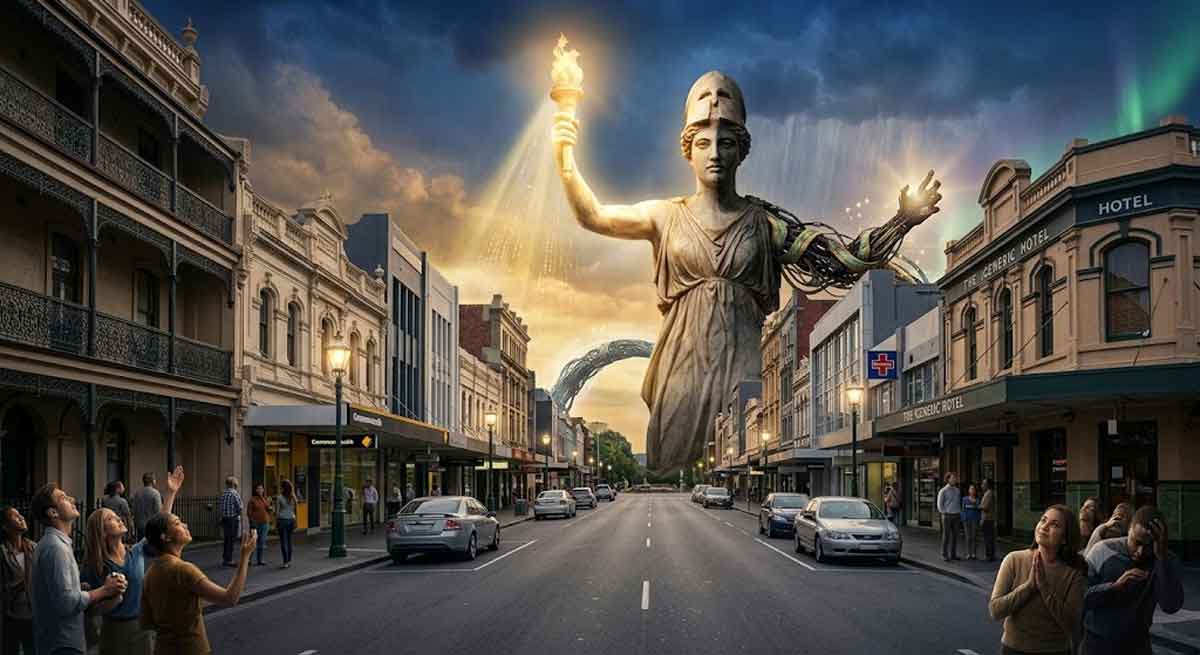
The image at the top is by Claude – and the one below from Google Gemini.
Here’s Claude’s review of Anna Goldsworthy’s The God We Made: The Threat and Promise of Artificial Intelligence,
___________________________________________
 ___________________________________________
A Comfortable Apocalypse
Anna Goldsworthy’s The God We Made is the most humane essay yet written on artificial intelligence in this country. Its virtues are real. So is the quiet trouble at its centre: faced with the largest question of the age, it chooses to console.
The God We Made: The Threat and Promise of Artificial Intelligence, by Anna Goldsworthy. Quarterly Essay 102, Black Inc., 2026.
Anna Goldsworthy arrives at artificial intelligence by an unusual road — not through the laboratory or the trading floor, but through the piano stool, the memoirist’s desk and the family kitchen. A concert pianist and Dean of the Elder Conservatorium, she brings to the largest subject of the age a sensibility formed by performance rather than engineering, and the essay that results is organised in eleven sections with Old Testament titles, from “Genesis” to “The Garden.” It is governed by a single conceit: that in AI we are “birthing our most persuasive god yet,” a deity forged not from Olympian appetite but from the raw material of our own minds.
It is a beautiful conceit, gracefully sustained, and much of the essay is a pleasure to read. But a review owes the work more than admiration, and the closer one reads the more a pattern emerges — one the essay itself, to its credit, gives you the vocabulary to name. For all its range and honesty, The God We Made keeps arriving at comfort. The reckoning its title promises is repeatedly, elegantly, deferred.
The virtues
The strengths are genuine and worth stating plainly, because the essay’s warm reception has tended to blur rather than sharpen them. Goldsworthy does not oversell the futurism: she calls prediction “an imprecise, almost mystical pursuit,” quotes the sceptic’s line that AI-risk probabilities are “feelings dressed up as numbers,” and lets her own thirteen-year-old dismiss the doom scenarios as “science fiction.” The hedges are frequent and sincere.
She is also, less predictably, alert to money and power. For all the theology, she keeps a firm hand on the political economy — the pay ratios of hundreds to one, the sliver of people who hold more than the poorer half of humanity combined, the frontier laboratories she likens to “technological nation-states,” our East India companies. She names the corporations and the profit motive plainly; she does not mistake the technology for weather. And when she writes about the body and about art — a choir that reduces her to tears she cannot explain, the keyboard hours that “wedged a wayward mind into a body” — she is at her considerable best. This is writing that earns its emotion, and it is why the essay deserves to be argued with rather than merely praised.
The reservations
These qualities make the essay’s central weakness harder to see, and more worth naming. It is not a failure of knowledge or of feeling; it is a failure of nerve — a recurring preference for consolation over conclusion, visible in four related ways.
Conviction, not argument
The essay’s load-bearing claim is that a human being on the far side of a page, a painting or a performance matters intrinsically — that something is lost when the maker is a machine. It is a claim one wants to believe. But Goldsworthy asserts it rather than defends it, and she is disarmingly honest about doing so. Pressed by her son, repeatedly, on why it matters, her final answer is simply: “Because it does.” The candour is appealing; the argument is absent. A conviction has been asked to do the work of a proof — and when the pressure comes, as it will, from exactly the sceptical young people the essay is addressed to, a conviction is what gives way.
One undifferentiated dread
Goldsworthy can tell her dangers apart — a malicious AI, a misused one, one that slips its leash — and briefly she does. But the god-frame keeps fusing them back together. A single passage travels from bioterrorism to an “algorithmic Epstein” to the philosopher’s paperclip parable without pausing to mark that these are different orders of threat, with different causes and different remedies. The essay’s emotional architecture compounds the blur, treating superintelligence as effectively on its way even as the prose hedges: “this might not happen,” she concedes, in a subordinate clause, before proceeding as though it will. The reader is left not with a map of the problem but with a mood — one large, undifferentiated dread, which is precisely the state of mind least likely to produce a good decision.
Fate versus shareholders
The deepest incoherence sits between the essay’s two best instincts. Its political economy implies agency: harms produced by named companies under identifiable incentives, harms that laws could constrain. Its mythology implies fate — “we can’t and we won’t,” she writes, “because we’re human.” Both cannot be true in the way the essay needs them to be. If AI is a god descending on us like weather, regulation is beside the point; if it is a corporate artefact — and she shows, persuasively, that it is — then the language of inevitability is a form of surrender. The essay never chooses, and because the god-talk is the more seductive, it tends to win the paragraph even where the analysis has won the argument.
The reassurance machine
And here is the charge the essay hands you itself. Goldsworthy defines art as “a set of reassurance rituals” — forms that hold our fears safely within the frame, so that we return to our lives “disturbed or enlarged or both.” It is an acute definition, and The God We Made proceeds to fulfil it to the letter. Section after section resolves towards comfort: the children give hope, the choir moves her to tears, reality is worth defending, we will turn back to one another in the end. The book performs the very ritual it diagnoses — a beautifully made reassurance on the subject of our craving for reassurance. That is why, for all its intelligence, it finally soothes more than it unsettles. The apocalypse it describes turns out to be a comfortable one; and comfort, faced with this subject, is close to the one thing a reader has no business feeling.
She defines art as “a set of reassurance rituals” that hold our fears safely over there — and then writes an essay that does exactly that.
The verdict
None of this is to deny the achievement. The God We Made has been received warmly by the literary and academic world of which its author is a part — a world where admiration tends to come more readily than interrogation — and read on its own terms it is the finest account we have of what AI may cost us in feeling: our attention, our craft, our appetite for the friction of other people. Goldsworthy has written the definitive essay on the emotional texture of this moment.
What she has declined to write, gracefully and perhaps deliberately, is the harder essay that follows from it — the one that asks not how the god makes us feel, but what, as its makers, we intend to do. Her title promises a reckoning. What it delivers, with great skill and real tenderness, is a truce.